A Song Worth Hearing
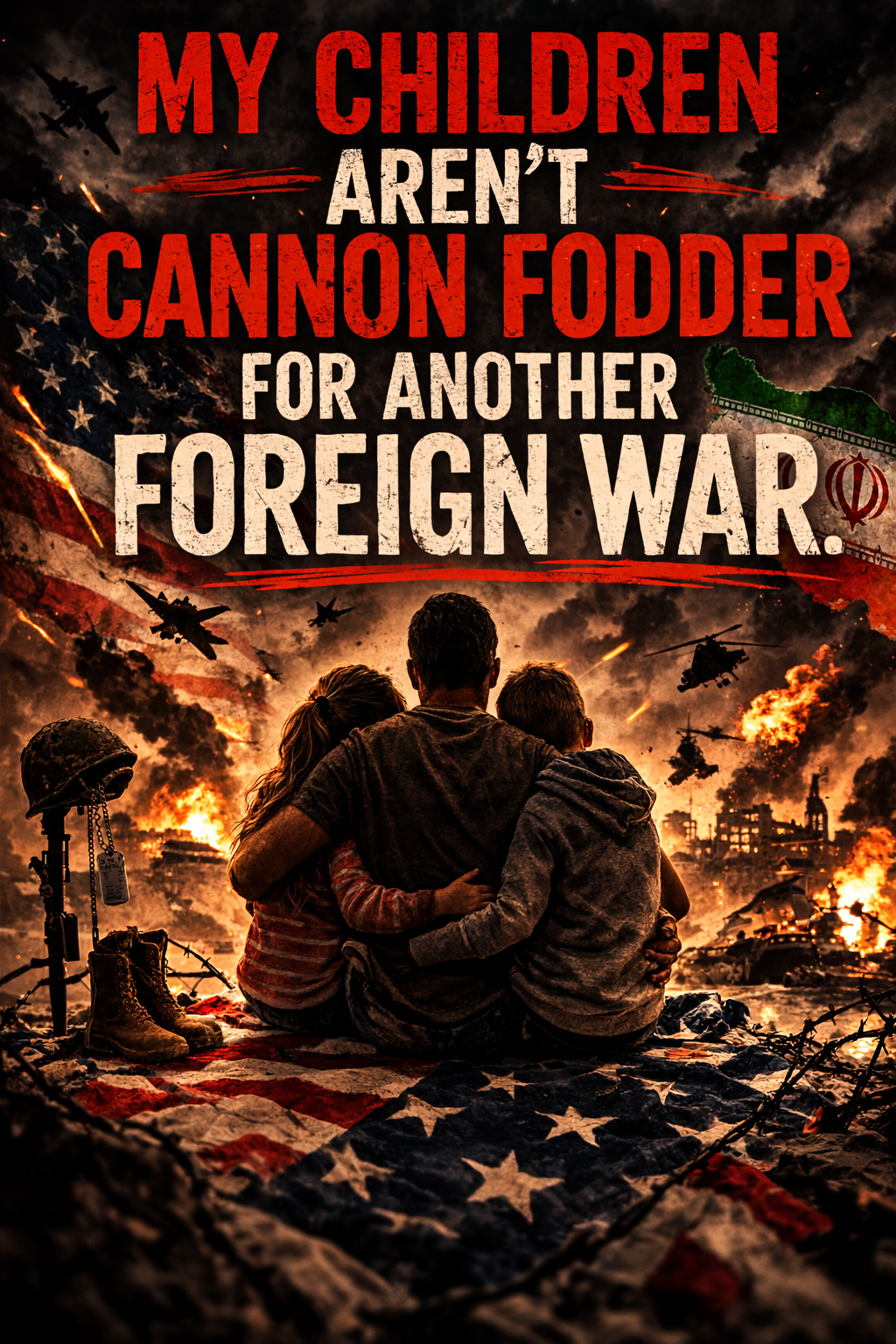
The war on labels is one we are all losing — quietly, slowly, and without noticing. Every time we reduce a human being to a single word — Muslim, Christian, Jew, American, Iranian — we take another step down a road that has no good ending. We are dying for identities we did not choose and enemies we were told to fear. The labels become the war, and the war becomes the reason for more labels. It is a machine that feeds itself, and every generation rediscovers this the hard way. Our children are not symbols. They are not cannon fodder for the next ideological campaign, the next foreign conflict dressed up in the language of existential threat. They are people — specific, irreplaceable people — and the moment we let a label stand in for that specificity, we have already lost something we can never win back.
As conflict in Iran dominates news cycles, social media timelines are filling with a predictable and deeply troubling pattern. People who would otherwise consider themselves reasonable are casually labeling all Muslims, all Jews, and all Christians as if their individual humanity is secondary to a group identity imposed on them from outside. The posts range from paranoid generalization to explicit hostility, and the throughline is the same: reduce a billion people to a single adjective, usually a negative one, and let that adjective do the work of thought.
We have been here before. And we know how it ends.
What Labels Do to People
Labels, at their most benign, are organizational shortcuts. They help us categorize a complex world. The problem arises when we apply labels designed for institutions, governments, or extremist ideologies to the full population of people who share a religion, ethnicity, or national origin.
When you label a government or a terrorist organization, you’re describing a power structure and its actions. When you label all Muslims, all Jews, or all Christians, you are doing something fundamentally different: you are stripping individual human beings of their personal identities, their moral agency, and their capacity to be judged on their own terms.
Labels applied to whole groups function in predictable psychological ways:
In-group/out-group hardening: Once a label defines “them,” it becomes easier to attribute any action taken by any member of that group to the group as a whole. A Muslim commits violence — all Muslims are violent. A Jewish politician supports a policy you dislike — Jews control politics. A Christian pastor says something bigoted — Christianity is bigoted. The individual act becomes proof of group essence. This is a logical fallacy (the representativeness heuristic run amok), but it feels like pattern recognition, which is why it spreads so easily.
Dehumanization through abstraction: It is very hard to inflict suffering on someone you see as fully human. It is considerably easier to harm an abstraction — a label, a category, a “them.” This is not an accident of psychology; it is a feature of how propaganda works. Before populations can be turned against each other at scale, the target group must first be transformed into something less than human through sustained labeling. The label doesn’t cause violence directly. It makes violence imaginable, then thinkable, then arguable, then — in the worst cases — actionable.
The false unity it implies: No religious group of any meaningful size is monolithic. Christianity encompasses liberation theologians in Latin America, Appalachian snake handlers, Ethiopian Orthodox monks, suburban American megachurch attendees, and Coptic Christians in Egypt — people with radically different politics, cultures, and interpretations of their own faith. Islam spans Sufi mystics who believe God is encountered in music and dance, Shia clerics in Qom, secular-identifying Muslims in Turkey, and Black American converts who came to the faith through the Civil Rights movement. Judaism includes secular Israeli socialists, ultra-Orthodox Hasidim who reject Zionism, Reform Jews in Chicago, and Yemeni Jewish communities with ancient traditions entirely distinct from European Jewish culture. A label that pretends these groups are unified by religion into a single political or moral entity is not describing reality — it is constructing a fiction, and fictions of this kind are dangerous.
The Road to the Holocaust: Labels as a Case Study
The Holocaust did not begin with concentration camps. It began with language.
The Nazi rise to power between 1933 and 1939 was accompanied by a sustained, state-sponsored, and eventually culturally ubiquitous campaign of labeling. Jews were labeled not as individuals, not as German citizens, not as neighbors, but as a collective enemy: rootless cosmopolitans, racial polluters, communist agitators, capitalist exploiters (often both accusations were made simultaneously without apparent irony). The labels were applied regardless of individual belief, politics, nationality, or behavior. A secular atheist of Jewish ancestry was as “Jewish” as a devout rabbi. A German veteran who fought in WWI was as Jewish as someone who had just immigrated.
The labeling process moved through identifiable stages that historians have documented carefully:
Classification: Defining who is “us” and who is “them” — the 1935 Nuremberg Laws codified in law what propaganda had been building in culture.
Symbolization: Making the label visible — yellow stars, mandated identifiers, public registration.
Discrimination: Legally codified exclusion from economic, social, and civic life.
Dehumanization: Propaganda campaigns characterizing Jews as rats, parasites, and disease — language that explicitly removed human status.
Organization: The machinery of persecution being formalized — SS, Gestapo, bureaucratized violence.
Polarization: Driving moderates out of the conversation and consolidating the extremes.
Preparation: Identification, property seizure, forced relocation.
Persecution: Mass violence, ghettoes, early mass shootings.
Extermination: The Final Solution — the attempted murder of an entire people.
Gregory Stanton, who founded Genocide Watch and whose work helped predict the Rwandan genocide, developed this framework — the “Ten Stages of Genocide” — to describe how mass atrocities unfold. Stage one is always Classification. Stage two is always Symbolization: the label made visible.
The Holocaust is the most studied example, but it is not the only one. The Armenian genocide began with labeling Armenians as a threat to the Ottoman Empire. The Rwandan genocide was preceded by Hutu Power propaganda that labeled Tutsis as “inyenzi” — cockroaches. The Cambodian genocide targeted intellectuals labeled as enemies of the revolution. In every case, the mass killing was enabled by sustained dehumanization, and dehumanization always begins with labels applied to whole populations.
The WWII Generation Understood This from the Inside
What makes the current moment especially frustrating is that the WWII generation — the people who actually lived through what labels can do — built institutions and laws specifically designed to prevent it from happening again. And many of those institutions are now under pressure from people who seem to have forgotten why they exist.
The Universal Declaration of Human Rights, drafted in the aftermath of the Holocaust, begins with the recognition that the atrocities of WWII grew from a failure to see all human beings as possessing inherent dignity regardless of group membership. Article 18 specifically guarantees freedom of religion precisely because religious persecution was one of the defining features of Nazi terror.
In the United States, Japanese-Americans were interned during WWII based on racial and national-origin labeling — 120,000 people imprisoned without individual due process. The U.S. government formally apologized for this in 1988 with the Civil Liberties Act and paid reparations. The lesson explicitly drawn from that episode was that wartime fear, when it attaches to a whole group label, produces injustice even in democracies that believe themselves to be rule-of-law societies.
The generation that came home from WWII having fought fascism — having seen what labels produced in Europe, having recognized the same tendency in the Japanese-American internment — made specific legal and cultural choices to guard against it. They expanded civil rights law. They built international human rights frameworks. They established genocide prevention institutions. They did these things because they knew from direct experience that the comfortable slide from “those people are a threat” to “those people must be stopped” is shorter than anyone wants to believe.
Why the United States Enshrined Freedom of Religion
The First Amendment was not an accident or an idealistic gesture. It was a direct response to lived historical experience — both the experience the founders brought from Europe and the experience of the colonies themselves.
The European Context: State Religion as a Tool of Oppression
The settlers who came to the American colonies in the 17th century were, in significant numbers, refugees from religious persecution. The Pilgrims fled England not merely for freedom to practice their own faith, but because the Church of England, backed by the power of the state, punished nonconformity with imprisonment, fines, and exile. The Puritans, the Quakers, the Catholics — all faced varying degrees of legal persecution because their faith made them members of a labeled out-group in a polity where religious identity and political loyalty were fused.
In Europe, the Wars of Religion — the Thirty Years’ War (1618-1648) alone killed an estimated 8 million people — demonstrated in blood what happens when states take sides in theological disputes. The Peace of Westphalia that ended the Thirty Years’ War established, for the first time in European history, the principle that sovereign states could determine their own religious character without outside interference. But it did not protect individuals within states from religious coercion by their own governments.
The English Civil War, the execution of King Charles I, the brief Puritan Commonwealth under Cromwell, the Restoration, the Glorious Revolution of 1688 — all of these upheavals had religious identity woven through them. By the time the American founders were writing constitutions, the relationship between state power and religious authority had been a source of war, instability, and bloodshed for 150 years in living European memory.
The Colonial Experience: Religious Persecution on American Soil
The colonies themselves were not uniformly tolerant. Massachusetts Bay Colony, founded by Puritans, banned other religions and banished Roger Williams in 1636 for advocating separation of church and state and religious tolerance. Williams went on to found Providence, Rhode Island, which became the first colony in America to guarantee freedom of conscience. Quakers were hanged in Massachusetts. Catholics faced legal disabilities in most colonies. Religious tests for public office were common.
Virginia, where many of the founders including James Madison and Thomas Jefferson lived, had an established Anglican church supported by tax revenue. Dissenters — Baptists, Presbyterians, Methodists — were legally disfavored. Baptist ministers were jailed in Virginia for preaching without a license in the years immediately before the Revolution.
James Madison witnessed Baptist ministers being imprisoned for preaching in Virginia in the 1770s. This direct experience shaped his lifelong conviction that the entanglement of government and religion was dangerous to both. Madison would go on to write the First Amendment.
The Founders’ Reasoning
The framers’ arguments for religious freedom operated on multiple levels:
Government has no legitimate authority over religious conscience: Thomas Jefferson articulated this in the Virginia Statute for Religious Freedom (1786), which predated and prefigured the First Amendment: “Almighty God hath created the mind free; that all attempts to influence it by temporal punishments or burthens, or by civil incapacitations, tend only to beget habits of hypocrisy and meanness.” The argument was that coercing religious belief not only fails (you can imprison a body, not a mind) but corrupts the coerced into performing faith they don’t hold, which corrupts religion itself.
Establishing one religion disadvantages all others: In a diverse colony — and the colonies were genuinely diverse in religious terms, even by 1776 — any established religion creates a system where adherents to minority faiths are second-class citizens. Madison argued in his “Memorial and Remonstrance Against Religious Assessments” (1785) that religious establishment corrupts both government and religion: it corrupts government by entangling it in theological disputes it has no competence to resolve, and it corrupts religion by making it dependent on state support rather than the genuine conviction of its adherents.
Historical evidence of what established religion produces: The founders were students of history. They knew what the Wars of Religion had produced. They knew what the Inquisition had produced. They knew what the conflict between Anglican establishment and Puritan, Catholic, and Dissenter populations had produced in England. The evidence of history was that fusing state power with religious authority led to persecution, war, and instability. The Establishment Clause of the First Amendment — “Congress shall make no law respecting an establishment of religion” — was not naivete. It was a learned response to documented historical catastrophe.
Protecting minority faiths protects everyone: Madison’s key insight was that in a large republic with diverse religious populations, no single denomination could dominate permanently, and this diversity was itself a protection for everyone. “In a free government the security for civil rights must be the same as that for religious rights. It consists in the one case in the multiplicity of interests, and in the other in the multiplicity of sects.” Religious diversity was a feature, not a bug — it prevented any single sect from accumulating the power to persecute others.
The Free Exercise Clause — “or prohibiting the free exercise thereof” — added the affirmative dimension: government could not merely refrain from establishing religion; it had an obligation not to interfere with individuals practicing their faith. Together, the two clauses created a framework where government was structurally excluded from taking sides in religious matters.
The Constitutional Settlement
When the First Amendment was ratified in 1791, it represented something genuinely new in world history: a major state explicitly abandoning the concept of religious establishment and protecting individuals’ right to practice any faith or none. This was not a statement of indifference to religion — many of the founders were deeply religious. It was a statement born of hard historical experience that the marriage of state power and religious authority was dangerous to both, and that religious pluralism, protected by law, was the only stable foundation for a diverse society.
The Treaty of Tripoli, ratified unanimously by the Senate in 1797 and signed by President John Adams, stated explicitly: “As the Government of the United States of America is not, in any sense, founded on the Christian religion…” This was not anti-religious sentiment; it was a formal diplomatic statement of the principle that the United States’ system of government was neutral as between religious traditions — which was what made it legitimate to adherents of all traditions.
What This Means for the Present Moment
The historical throughline is not subtle. Wartime fear produces a desire for simple explanations and clear enemies. Clear enemies require labels. Labels applied to whole populations have a documented, repeating, catastrophic pattern of outcome.
The current labeling of all Muslims as threats because of an Iranian government’s actions is equivalent — structurally, logically, historically — to labeling all Germans as Nazis in 1943, or all Japanese-Americans as spies in 1942. It conflates a government with its people, a political/military entity with a religious tradition that spans 1.8 billion individuals across 50 countries, most of whom have no more connection to the Iranian government’s policies than a Protestant in Tennessee has to the historical actions of the Vatican.
The labeling of all Jews as agents of any particular political interest repeats, with eerie precision, the structure of antisemitic conspiracy theory that the Nazi propaganda machine weaponized. Antisemitism does not require consciously hateful intent to spread — it spreads through casual generalization, through “just asking questions,” through applying to a whole people the actions of some members or the policies of a distant government.
The labeling of all Christians as bigots, warmongers, or hypocrites based on the actions of some — whether that’s televangelists, Christian nationalist politicians, or historical crusaders — makes the same structural error in a different direction.
The answer is not to pretend that religious institutions, governments, or movements have no political dimension. They do. Specific actions by specific actors can and should be criticized on their merits. The Iranian government’s actions in the current conflict are the actions of a specific government and can be criticized specifically. Hamas’s attacks are the actions of a specific organization. The actions of specific Christian nationalist political movements are the actions of specific political movements. None of these require labeling everyone who shares a faith as collectively responsible or collectively suspect.
The First Amendment’s guarantee of religious freedom is not just a legal technicality. It is a codified version of a hard historical lesson: that when governments — or cultures, or social pressure — treat religious identity as a marker of political loyalty or threat, the results are catastrophic for everyone. The founders built freedom of religion into the first line of the first amendment because they had enough historical knowledge, and enough direct experience, to know what happens when you don’t.
The WWII generation built international human rights frameworks around the same lesson, learned at a cost of 70-85 million lives.
We do not have to relearn this lesson from scratch. We just have to remember it.
The views expressed here are personal perspectives on history, civil liberties, and current events. This post draws on documented historical record and the writings of the American founders.