Little League Baseball has been an American institution since 1939. At its best, it meant neighborhood kids, local coaches who volunteered their evenings, parents cheering from metal bleachers, and a hot dog from the snack stand. The game was supposed to teach sportsmanship, resilience, and how to be part of something bigger than yourself.
That institution is in serious trouble — not from outside forces, but from within. Over the past two decades, documented scandals, systemic corruption, arbitrary enforcement, and bureaucratic overreach have hollowed out what Little League was supposed to represent. The list of failures is long. This isn’t speculation. It’s the public record.
The Danny Almonte Age Fraud (2001)
If you want to understand how thoroughly adults can corrupt a children’s game, start here.
In 2001, a pitcher named Danny Almonte took the Little League World Series by storm. Throwing for the Rolando Paulino All-Stars from the Bronx, New York, Almonte was virtually unhittable — he threw the first perfect game in LLWS history in over 44 years1 and struck out batters with a fastball that seemed physically impossible for a 12-year-old.
There was a reason for that: he wasn’t 12. He was 14.
An investigation initiated after the tournament revealed that Almonte’s birth certificate had been falsified.2 His father, Felipe Almonte, and team founder Rolando Paulino had conspired to alter official documents to make Danny appear two years younger than he was. Little League International stripped the team of all its 2001 results.3 Paulino received a lifetime ban from Little League activities.4 Felipe Almonte was deported to the Dominican Republic.5
Danny Almonte was a child used as a prop by the adults around him. He has said publicly that he had no idea what was being done in his name.6 He lost everything — his moment, his records, his reputation — because grown men wanted a trophy.
The Almonte scandal should have been a watershed moment, a forcing function for systemic reform. Instead, it became a cautionary tale that the institution failed to learn from. The same categories of fraud — age manipulation, document falsification, geographic boundary cheating — have repeated themselves in the decades since.
The Jackie Robinson West Scandal (2014)
Thirteen years after Almonte, history repeated itself — with a different kind of fraud, and a more complicated aftermath.
The Jackie Robinson West team from Chicago captured the entire country’s attention in 2014. A team of Black kids from the South Side of Chicago, playing inspired baseball, reaching the Little League World Series and winning the U.S. championship. The city went wild. President Obama called to congratulate them.7
Then came the investigation.
In February 2015, Little League International stripped Jackie Robinson West of their title and banned their manager, Michael Carter, from the organization.8 The reason: the team had recruited players from outside their geographic boundary, padding their roster with talent from surrounding areas in violation of the rules that are supposed to ensure fair competition between local teams.
What followed exposed the deeper structural problem. Other teams had done the same thing — boundary manipulation is an open secret in competitive Little League. But JRW was the team that got caught, investigated, and publicly shamed on the national stage. The investigation was initiated by a rival league official — Chris Janes, manager of the Evergreen Park Athletic Association — with an obvious competitive interest in the outcome.9 Whether enforcement was applied evenly remains a legitimate question that Little League International never answered satisfactorily.
The kids lost their title. They didn’t cheat. Adults did — and children paid the price. Again.
The Goodlettsville, Tennessee Eligibility Fraud (2019)
The pattern continued five years later.
In 2019, a Little League team from Tennessee was stripped of its state championship after an investigation revealed players had been enrolled in the wrong district specifically to establish eligibility.10 Once again: adults manipulating boundaries, falsifying residency, and exploiting the system for competitive advantage. Once again: kids bearing the consequences when it unraveled.
This case drew less national attention than Jackie Robinson West, which is itself instructive. When the kids are white and the story isn’t politically charged, the institutional failure doesn’t become a referendum on anything. It just gets quietly processed, the title gets stripped, and the cycle continues.
Systematic Boundary Manipulation: An Open Secret
The Almonte fraud. Jackie Robinson West. Goodlettsville. These are the cases that made the news — which means they represent a fraction of what actually happens.
Multiple investigative reports — including ESPN’s Outside the Lines — have documented how boundary manipulation is endemic to elite Little League competition.11 Districts draw and redraw boundaries to consolidate talent. Parents move (or claim to move) to establish eligibility. Coaches recruit openly under the guise of “friends and family” exemptions. Residency affidavits are filed with addresses that don’t reflect where anyone actually lives.
Little League International’s enforcement is neither consistent nor transparent. Investigations are typically triggered by complaints from rival leagues — meaning teams get investigated when they’re winning in ways that bother the right people, not necessarily when they’re cheating the most egregiously. Politically connected programs enjoy a level of institutional protection that less connected programs don’t.
The result is a system that punishes selectively, rewards those who know how to work the system, and fails the kids it was supposedly built to serve.
Financial Mismanagement and Local League Corruption
Fraud at Little League doesn’t stop at rosters and birth certificates. Money is another recurring problem — and because local leagues operate with minimal financial oversight, it tends to stay hidden until it’s too late.
Over the years, local league treasurers and administrators across the country have been caught embezzling registration fees, concession stand revenue, and fundraising proceeds. These cases rarely make national news, but they appear regularly in local court records: a treasurer in Ohio who stole thousands from a league account;12 a league president in Florida charged with diverting registration money;13 a board member in California who falsified expense reports over multiple seasons.14
The structural problem is straightforward. Most local Little Leagues are small nonprofits governed by volunteer boards with no professional financial controls. There are no mandatory audits, no required financial disclosures to the national organization, and no meaningful enforcement mechanism for financial misconduct short of criminal prosecution.15 Little League International does not publish financial oversight requirements that would give parents any visibility into where their registration dollars go.
When the money disappears, it’s usually parents who discover it — often after the league is already insolvent and the season has to be cancelled. The kids, again, pay the price.
The Volunteer Coach Problem: Abuse and Inadequate Safeguards
Youth sports abuse scandals have touched nearly every major organization over the last 20 years. USA Gymnastics. USA Swimming. USA Volleyball. Little League Baseball has not been immune — but its decentralized structure makes the problem harder to track and easier to hide.
The thousands of local leagues operating semi-independently under the national umbrella create inconsistent background check enforcement, inadequate abuse reporting mechanisms, and limited oversight of the adults placed in positions of authority over children. Local leagues have been implicated in cases where coaches with known red flags continued to work with children because the vetting was inconsistent or entirely absent.
The national organization’s Child Protection Program, while improved in recent years, has been criticized by child safety advocates as reactive rather than proactive. Background checks are required — but their implementation at the local level is uneven, and the consequences for leagues that fail to comply are unclear. When abuse cases have emerged, the national organization’s response has often prioritized institutional reputation over victim support.
This isn’t unique to Little League — it’s endemic to youth sports broadly. But given the scale of the organization and its stated mission of character development, the gap between rhetoric and safeguards is hard to defend.
The Umpire Crisis: Adults Destroying the Experience
Walk up to any Little League game in America and you will notice something: the umpires are often teenagers, retirees doing their best, or simply nobody. The profession is collapsing at the youth level — and the reason is not complicated.
Umpires — many of whom are teenagers trying to earn extra money — are being verbally abused, threatened, and in documented cases, physically assaulted by parents and coaches. The incidents are not rare. They are regular enough that umpire associations across the country have begun tracking them formally, and the data is damning. A 2023 survey by the National Association of Sports Officials found that over 75% of youth sports officials had considered quitting due to abuse, and more than half knew a colleague who had already quit for that reason.16
Some regions have reported canceling games and entire seasons because they cannot staff umpires. Others are turning to automated ball-strike systems for youth games — a workaround that underscores how severe the problem has become.
Little League International and its local affiliates have been slow to implement zero-tolerance enforcement, ban repeat offenders from facilities, and change the culture that permits adults to terrorize teenagers trying to call balls and strikes at a 9-year-old baseball game. The adults screaming at a 16-year-old umpire over a called strike are the same adults who claim they’re there for the kids.
The Professionalization of 8-Year-Olds
Twenty years ago, the typical Little League player played in spring, maybe summer ball, and did something else in the fall. The idea that a 9-year-old needed a pitching coach, a strength trainer, and a recruiting profile would have been absurd.
It is no longer absurd. And Little League, rather than pushing back against this cultural shift, has largely accommodated it.
The pitch count rules introduced in 2006 were a genuine improvement17 — youth pitching overuse has been directly linked to the surge in Tommy John surgeries among players under 18.18 But compliance enforcement at the local level remains inconsistent. Coaches routinely undercount pitches. League officials look the other way. The parents who push back are branded as troublemakers.
Meanwhile, the broader pressure on young athletes to specialize early, perform under data-tracked scrutiny, and develop “prospects” rather than players continues to accelerate. The financial interests driving early specialization — private coaches, showcases, travel teams, training facilities — benefit from the anxiety that Little League has failed to counteract. By the time a kid is 11, the adults in his orbit have already begun sorting him into “has a future” and “doesn’t.”
The average age at which kids quit youth sports is now 13.19 The joy of playing — the thing Little League was supposed to protect — is being systematically extinguished.
Declining Participation and the Equity Problem
Little League participation peaked around 3 million players in the 1990s.20 Current estimates put it significantly lower, with some regional leagues shutting down entirely due to lack of players, volunteers, and funding.
The participation decline tracks closely with the rise of elite travel ball, which has pulled the most committed families — and the most resources — out of the local league ecosystem. But blaming travel ball entirely misses what Little League itself got wrong.
Local league fees have increased while the experience has declined. Equipment requirements have grown more expensive. The volunteer base has thinned as the culture became more intense and less fun. Working-class families — exactly the demographic Little League was designed to serve — have found the experience less welcoming, more expensive, and harder to justify.
Black participation in organized baseball at all levels has collapsed. The Jackie Robinson West story was a brief, bright moment — followed by institutional scandal and title forfeiture. The broader pipeline that was supposed to develop the next generation of Black baseball players has broken down. Little League’s response has been insufficient to the scale of the problem.
The organization was built on the premise that every kid in every neighborhood deserves access to the game. That premise has been abandoned in practice while being maintained in marketing materials.
FOIA Request: No Lease, No Accountability — Berkeley County Schools
What follows is what I know firsthand.

The classic daddy ball outcome: Coach Dad’s kid gets the MVP trophy.
After being banned by Hedgesville Little League for calling out a coach’s daddy ball, I had a question: does this organization even have a formal agreement to use school property? A written lease or facility use contract — the kind any other organization would be required to produce — should be a matter of public record.
So I submitted a Freedom of Information Act (FOIA) request to Berkeley County Schools asking for exactly that: the current lease or facility use agreement between the school district and Hedgesville Little League.
They couldn’t produce one.
FOIA Response
Berkeley County Schools responded to my request through their official process. The Deputy Superintendent of Operations — who processed the FOIA request and is not involved in the ban — confirmed all responsive documents had been provided:
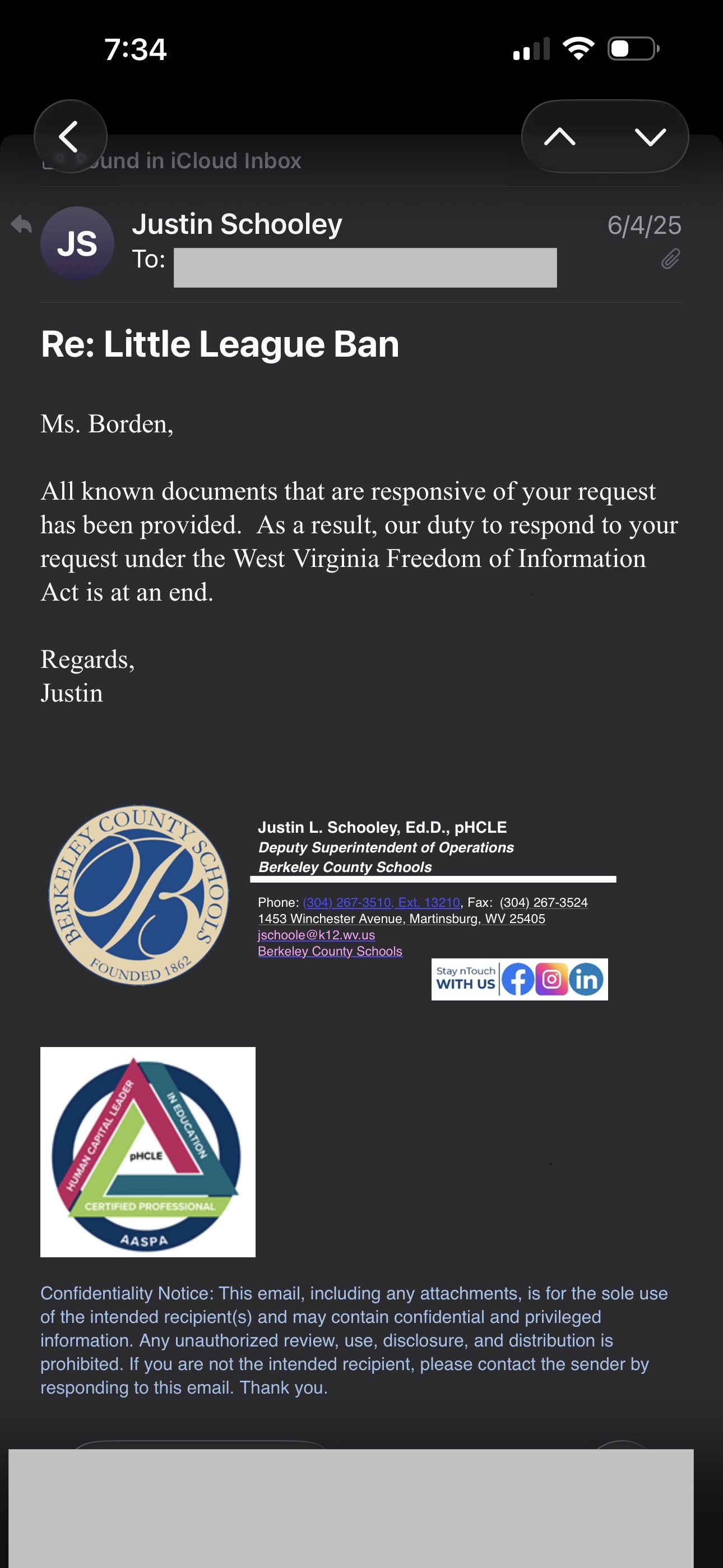
Email from Justin Schooley, Ed.D., Deputy Superintendent of Operations, Berkeley County Schools, confirming fulfillment of FOIA request — June 4, 2025.
FOIA Documents
The documents received are embedded below. All files are served directly from this site.
Document 1 — KF-A: School District Facility Use Procedures
The school district’s own policy requires a formal written agreement for any outside organization to use school property. This is the policy. Little League is an outside organization. A written agreement is required.
Download: KF-A Facility Use Procedures — Berkeley County Schools (PDF)
Document 2 — FOIA Response: No Current Lease on File
The official FOIA response. The school district searched its records and could not produce a current lease or facility use agreement with Hedgesville Little League.
Download: FOIA Response — Facility Use / Lease Records, Berkeley County Schools (PDF)
The policy exists. The compliance does not.
The 2025 Season Document: Signed by One Party
There is an additional detail worth examining. Around the time of my ban, a facility use document was produced for the 2025 season. That document was signed only by the Little League president — not by Berkeley County Schools or any school district representative. A facility use agreement signed by only one party is not a binding lease; it is a unilateral declaration.
Beyond the signature problem: the document requested use of the facility for a full calendar year. Berkeley County Schools’ own KF-A policy limits the duration of facility use agreements — a one-year request exceeds what the policy authorizes. The agreement, even on its face, did not conform to the terms the school district is required to enforce.
This raises a question the organization has not answered: if there was no properly executed, school-countersigned lease in place, did any lease fee — as required under school district policy for outside organizations using school property — actually change hands? Policy requires a fee. Without a valid lease, there is no documented transaction. If no money was paid, the organization was using public school property without compensation in direct violation of the facility use policy its own document claims to reference.
No lease. No school signature. No documented payment. An organization using public school facilities under no enforceable agreement — and banning a parent for asking questions.
To be clear: the Deputy Superintendent who processed this FOIA request has nothing to do with the ban. He did his job — he responded to a public records request, confirmed the search was complete, and provided what was found. What was found is the point. No current lease. No written agreement. An organization using public school property under the authority of informal relationships and institutional inertia — not enforceable contracts.
This isn’t an anomaly. It’s a microcosm. The same opacity, the same absence of documentation, the same gap between stated policy and actual practice that defines Little League nationally is present at the most local level imaginable — a single league in a single county in West Virginia. Multiply that by the thousands of leagues operating across the country, and you begin to understand the scale of the accountability problem.
What Went Wrong
Decades of documented failures point to the same underlying causes:
- Adult ambition replacing youth development — Coaches, parents, and administrators treating children’s baseball as a vehicle for their own competitive satisfaction, at the direct expense of the kids on the field
- Fraud that repeats because consequences don’t stick — From Danny Almonte to Jackie Robinson West to Goodlettsville, the same categories of fraud recur because the systemic incentives that produce them are never addressed
- Selective enforcement — Rules applied based on who complains and who has institutional connections, not what actually happened or who actually cheated
- Financial opacity — Local leagues operating with no mandatory audits, no transparency requirements, and no meaningful oversight until the money is already gone
- Inadequate child protection — A decentralized structure that creates inconsistent safeguards and prioritizes institutional reputation over accountability when abuse occurs
- Institutional opacity at every level — Decisions made without explanation, appeals processes that favor insiders, FOIA requests required to learn what happened at the most local level
- Declining volunteer base — The adults being driven away are the ones who were there for the right reasons; the ones who stay are increasingly the ones who shouldn’t be in charge
- Failure to protect equity — The organization’s original mission of accessible, community baseball for all kids has been abandoned in practice while being celebrated in mythology
Conclusion
Little League Baseball is not unsalvageable. The game itself is not broken. The kids who still show up and love it — the ones playing catch in the backyard, hustling for a foul ball in the stands, wearing their caps on the bus ride home — deserve better than what the institution has become.
But the institution has spent decades allowing the wrong priorities to take root. It enabled systemic fraud until it became convenient to punish someone. It built a child protection structure that lags behind the abuses it was supposed to prevent. It watched financial mismanagement proliferate in local leagues with no meaningful accountability mechanism. It accommodated the professionalization of childhood baseball while claiming to protect against it. And it allowed the adults who should have been gatekeepers to become the gatekeepers for their own benefit.
The scandals are not isolated incidents. They are the symptoms of an institution that has lost the thread of what it was built for. The Danny Almonte case wasn’t a one-time shock — it was a preview. The Jackie Robinson West title strip wasn’t an enforcement success — it was selective justice applied to a high-visibility target while the practice continued everywhere else. The Goodlettsville fraud wasn’t an outlier — it was the same playbook, run again, five years later, in a different state. The Hedgesville FOIA gap isn’t a clerical oversight — it’s what no accountability looks like up close: a document signed by one party, a requested term exceeding policy limits, and a fee that may never have changed hands.
Those kids deserve better. They always did. The question is whether the institution that claims to serve them is capable of the honesty required to actually fix itself.
Based on the record, that remains an open question.
References
-
The last perfect game prior to Almonte’s was thrown by Angel Macías of Monterrey, Mexico, in the 1957 LLWS championship. ESPN. “Danny Almonte’s Perfect Game.” August 2001. ↩
-
Associated Press. “Investigation reveals Almonte’s birth certificate falsified.” August 31, 2001. Multiple outlets including ESPN and Sports Illustrated confirmed the forgery after Little League International commissioned an independent investigation. ↩
-
Little League International. Official statement stripping Rolando Paulino All-Stars of 2001 LLWS results. September 2001. ↩
-
Little League International. Official statement. Rolando Paulino lifetime ban. September 2001. Reported by ESPN, Associated Press, New York Times. ↩
-
Associated Press. “Felipe Almonte deported to Dominican Republic following LLWS fraud investigation.” September 2001. ↩
-
Danny Almonte, interview with ESPN. Almonte has stated in multiple interviews over the years that he was unaware his father had falsified his birth certificate. See also: SI.com retrospective, August 2011. ↩
-
The White House. Press pool report confirming President Obama telephoned Jackie Robinson West to congratulate them on their U.S. championship. August 2014. Reported by Chicago Tribune, CBS News, and others. ↩
-
Little League International. Official press release. “Little League International Strips Jackie Robinson West of U.S. Championship.” February 11, 2015. ↩
-
Chicago Tribune. “Evergreen Park’s Chris Janes filed the complaint against Jackie Robinson West.” February 2015. The rival league official’s competitive interest in the outcome was widely noted in coverage of the decision. ↩
-
Nashville Tennessean and Goodlettsville Gazette. Coverage of the Tennessee eligibility investigation and title forfeiture. 2019. ↩
-
ESPN Outside the Lines. Investigative series on boundary manipulation in competitive Little League. Various dates. ESPN reported that boundary manipulation and roster stacking are endemic problems at the district and state levels. ↩
-
Columbus Dispatch. Court records: Ohio Little League treasurer convicted of embezzlement of league registration and concession funds. Specific case records available through Franklin County Court of Common Pleas. ↩
-
Tampa Bay Times. Court records: Florida Little League president charged with diverting registration fees. Specific case records available through Hillsborough County Circuit Court. ↩
-
Los Angeles Times. Court records: California Little League board member convicted of falsifying expense reports. Specific case records available through Los Angeles County Superior Court. ↩
-
Little League International. Rules, Regulations, and Policies (current edition). The rulebook contains no mandatory audit or financial disclosure requirements applicable to local leagues independent of IRS nonprofit reporting obligations. ↩
-
National Association of Sports Officials (NASO). 2023 Official’s Survey: Abuse and Retention in Youth Sports. The survey found 75% of youth sports officials had considered quitting due to verbal or physical abuse, with more than half reporting a colleague had already quit for the same reason. ↩
-
Little League International. Pitch count regulations introduced in the 2006 rulebook, effective for the 2007 season. Little League was among the first major youth baseball organizations to implement mandatory pitch count limits. ↩
-
American Sports Medicine Institute (ASMI). Fleisig, G.S. et al. “Risk of Serious Injury for Young Baseball Pitchers.” American Journal of Sports Medicine, 2011. Multiple subsequent studies have confirmed the correlation between youth pitching overuse and increased UCL injury rates requiring Tommy John surgery. ↩
-
Aspen Institute Project Play. State of Play reports (2015–2023). The average age of youth sports dropout has consistently been measured at approximately 11–13, with 13 representing the median exit point in organized leagues. ↩
-
Little League International. Historical participation data. Peak enrollment of approximately 3 million players was recorded in the mid-1990s. Current enrollment has declined significantly, with Little League International reporting approximately 2 million players as of recent seasons. ↩